“Women Law Firms” began in 1871 or earlier

A search through Newspapers.com and Genealogybank.com reveals that women began forming “women law firms” from quite an early date:

+++++In 1871, Miss Mary Wattle & Mrs. Helen Comb formed a woman’s law firm in Kansas, and, in 1880, Miss Frederika Perry and Miss Ellen Martin formed the “only ladies’ law firm in Chicago.” New Orleans Item, 28 November 1880.
+++++One of the newspapers announcing the formation of Wattle & Comb wondered, “Kansas has a female law firm — Miss Mary Wattle and Mrs. Helen Comb being the ingredients.  What’ll become of us if this sort of thing gets to be fashionable?” Austin Weekly Statesman, 1 August 1871.
+++++In 1881, according to the Hancock Democrat, “There [were] one hundred and forty women law firms in the United States.”  I’m not clear on the meaning of “women law firms” in that quote.   Flash:   I just found a story that conveyed a woman in solo practice was considered a “woman” or “women law firm.”  That makes much more sense of the “one hundred for women law firms.”  For the rest of this post, I refer only to women firms of more than one woman.
+++++In November of 1905, the Albuquerque Citizen reported that “New York has its frist [sic] female law firm.”  “A full fledged lady firm appeared in court this week . . . The firm’s name is Ashley, Pope & Doty — that is, Misses Jessie Ashley, Elizabeth S. Pope, and Madeline Z. Doty.”
+++++In 1912, Miss Anna Donahue and Miss Tiera Farrow formed Kansas City’s first exclusively women’s law firm.
+++++One year later, the Lima News reported that, in Chicago, “Katherine S. Clark, Phillis M. Kelly and Mary A. Sellers form[ed] the first all-women law firm in the country. They’re all brunettes.”  3 October 1913.
+++++According to the Indianapolis Star, on March 1, 1914, Miss Georgia Harrington and Miss Charline Hinkle “announced they probably will establish a law firm of their own, which it is believed will be the first women law firm in the country.”
+++++A headline in the Washington Post, in 1917, trumpeted, “First Women’s Law Firm in District; Just Like Men’s Save for Flowers.” Miss R. L. Halpenny and Miss Lucile Compton were the members of the women’s law firm. The writer of the article visited the firm and found “just one thing to distinguish [the office] from the office of a man’s law firm, and that was a bouquet of flowers on a tabouret between the desks of the firm’s members.” Miss Compton told the reporter, “Neither of us is a militant suffragist. We just feel as if we are competent to practice law . . . ”  22 February 1917.
+++++Two women formed the first woman law firm in Macon, Georgia, in February of 1921. “In announcing the partnership, Mrs. Napier said she realized they have a long, hard road to travel, but that they both love the law . . . . ‘The lawyers, and especially the judges, have been lovely to us,’ said Mrs. Napier, ‘and have volunteered to co-operate with us in every way.’ Mrs. Napier will handle the court cases and Miss Hardin will look after the office work.” The Atlantic Constitution, 12 February 1921.
+++++Milwaukee, in 1921, was the home of the first woman’s law firm in Wisconsin.  “A dream of girlhood days came true . . . when Geraldine V. McMullen and Rose Horwitz” formed their firm. “The shingle, McMullen & Horwitz, will announce that Milwaukee’s fair sex will have women champions.” The Capital Times, 8 March 1921.
+++++In early 1933, in Ohio, eight women lawyers “who got tired of having men for bosses banded together . . . [and] hung out a shingle of their own.” Evening Independent, 19 January 1933. They expected to have an advantage over firms of male attorneys — “Some women, particularly those with domestic difficulties, like to take their troubles to women.” Ironwood Daily Globe, 19 January 1933.
+++++A one-line post in the Charleston Daily Mail informed readers that “An all-woman law firm has organized in Boston to handle cases for members of their sex.” 22 February 1933.
+++++Again in 1933, three young women attorneys formed a woman’s firm, Seare, Meagher & Seare, after graduating from the University of Utah law school. Salt Lake Tribune, 9 February 1933.

SaltLakeTribune, 2/9/1933

SaltLakeTribune, 2/9/1933

+++++That same year, the Pampa Daily News included a seemingly challenging statement, “Modern Portias are banding to form wholly feminine law firms. We’ve been in courtrooms of many states, but we still look forward to seeing a firm like that tangle with one of our hard-hitting male partnerships.” 23 June 1933.
+++++Several newspapers, in April 1937, displayed a large photo with the headline, “The Coast’s All-Women Law Firm,” and the caption, “Boasting they comprise the first all-women law firm on the Pacific Coast, these three Los Angeles girls have organized a partnership that they used to dream about while they were in law school.”  The three lawyers are “all set as a unit to fight the world’s battles.”

News-Review, 4/28/1937

News-Review, 4/28/1937

+++++Again in 1937 and then in 1944, newspapers reported on “women’s law firms” in Kansas City and Baltimore.  According to the Daily Courier, Sep. 14, 1937, “What is believed to be the first women’s law firm opened here . . . .”   The all-woman law firm in Baltimore, reputed to be the first in Maryland, said that “most of its clients are men.”  Rushville Republican, 7 July 1944.  “The firm explains that it specializes in domestic cases, and although many of the men’s wives ‘don’t understand them,’ they seem to think ‘only a woman lawyer can understand how they are misunderstood.'”
+++++From the turn of the twentieth century, year after year, women lawyers established “feminine” law firms.  I wonder what happened to them and how the members of the firms fared in the legal world of those times.

Admission to U. S. Supreme Court Bar in 1880


19 February 1880 — Kinston Journal

+++++++++++++++“A Remarkable Incident”

+++++“Nothing more plainly shows the wonderful changes made in the past few years than an incident that recently occurred in the Supreme Court of the United States. This tribunal is justly considered the most august body of men in American, being the highest Court of nearly fifty millions of people. No lawyer can be admitted to practice at its bar, unless he is learned in the law and his character is vouched for by some other lawyer in good standing. The incident, to which we allude, took place last week, and was the admission of a negro lawyer upon the motion of a woman! This was not so remarkable because the lawyer was a negro, for there have been five of that race admitted as members of that bar, but because it was a negro vouched for by a woman lawyer. Truly is this a ‘progressive’ age, and wonderful are the changes wrought by it. The idea of women and negroes practicing at the bar of the United States Supreme Court! — Chatham Record.”


4 March 1879 — Inter Ocean

+++++++++++++++“A Woman Lawyer in the Supreme Court”

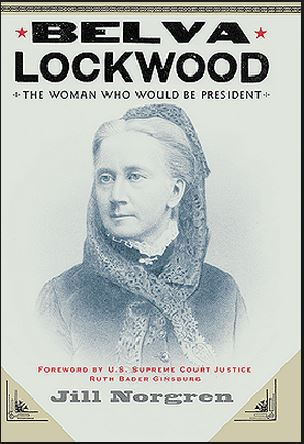
+++++“The Supreme Court-room was crowded with people this morning, it being expected that Mrs. Belva Lockwood, the woman lawyer, would again apply for admission to the bar, which was refused a year ago, but to which she is now entitled, under the bill recently passed by Congress. Mrs. Lockwood was present, waiting for the motion of admission to be made by ex-Congressman Riddle, of Ohio, who is now District Attorney. She was in a plain black suit. Her face wore a look of painful anxiety, and she was constantly in whispered conversation with the strong-minded women who accompanied her to furnish moral support. A motion to admit her was made, and she was sworn in just as men are, and, for the first time in the history of the Supreme Court, there is a woman on the roll of attorneys.”

lockwoodwiki

lockwoodwiki

bookjacket

bookjacket


“Two-Gun Gal Draws a Bead on Presidency” — Louise Replogle


May 25, 1949 — Richmond Times Dispatch

+++++“O. Louise Replogle, a two-gun [MONTANA] gal from the wild and wooly West, took a bead on the White House today and allowed as how she might aim to take it over as the first woman President around about 1980.
+++++Miss Replogle figures she has a running start on almost any other potential candidate — male or female — for commander-in-chief 31 years from now.
+++++And pardner, she’ll draw on the first hombre who challenges her.
+++++At the age of 25, the tall, pretty girl is serving her second term as county attorney of Fergus County, Mont.
+++++She’s a dead shot with an old-fashion frontier muzzle loading rifle and an expert at rounding up cattle while riding horseback.
+++++Miss Replogle was elected to the country attorney post at the tender age of 23, fresh out of the Montana State University law school. She used her feminine wiles for the good of the Republican party while her father, a devout Democrat, sat at home in Lewistown and fumed furiously.
+++++Bert Replogle thought he was getting even with his turncoat daughter when, as defense attorney in her first case, he gave her a sound legal spanking. But that didn’t stop her. She continued to live at home peacefully with the family and last year she was reelected with hardly any competition at all. The Democrats didn’t even nominate anyone to run against the crusading ‘favorite daughter’ of the bitterroot State. Now she’s thinking about plucking off juicier political plums in future elections.
+++++Miss Replogle stopped off in New York on her way home from a New York State Young Republican meeting at South Fallsburg, N. H.  As assistant secretary of the National Young Republican’s Club, she gave the delegates a pep talk that convinced anyone within shouting distance that Opal Louise Replogle was in the business of politics to stay.
+++++When she gets back home, Miss Replogle is going to conduct a big crusade to drive slot machines out of Fergus County, and she’ll take her case to the Supreme Court if she has to.  She said the 7,500 people in Lewistown are beginning to sit up and take notice of her work, instead of laughing and saying they could remember when Opal Louise was a chubby little girl in pigtails.
+++++‘The men have been very nice to me,’ she said, ‘although they’re probably hoping I’ll marry and settle down in the kitchen soon. The older lawyers have given me help when I needed it, and they don’t seem to object to having a woman running the legal end of the county.
+++++‘I guess they remember the day I won the Davey Crockett shooting match with an antique rifle and hardly any practice.  Some people have been calling me “One-Shot” Replogle ever since.  I do hope they were referring to my shooting and not to my success in politics.'”


[In 1956, Louise Replogle married Wellington Rankin, and, one year after he died, she married Jack Galt. She was active in the Republican party throughout her life.]

For more about Louise Replogle Rankin Galt, see https://mtwomenlawyers.org/1940-1949/opal-louise-replogle-rankin-galt-46/

September 9 — “The Woman Lawyer”


October 29, 1891 — The Daily Times (New Philadelphia, Ohio)

+++++“A woman student of the law, whether in an office or a law school, has some peculiar experiences. To a single woman among a class of men, the dilemma of the lecturers as to a fitting mode of address is amusing. Most of them will gaze anxiously around, and, fixing the eye upon the lone female, with a slight bow will open the discourse with the word ‘Gentlemen.’ One professor was always careful and courteous enough to begin with the phrase: ‘Lady and gentlemen!’
+++++It is also amusing and gratifying to see the refining effect of the lady’s entrance into the lecture hall of the library of the school. If the upraised masculine feet do not at once and voluntarily come down from the table top or back of the next chair, they are assisted to their rightful place on the floor by the hands of some fellow student. Of course there are always some men who heartily disapprove of a woman’s presence within the walls of the law school, and are pleased to show their disapproval in any way short of actually rude conduct. I have never known of systematically rude behavior toward a woman law student.
+++++When the woman lawyer puts out her shingle, or in modern fashion inscribes her name on the marble tablets at the entrance of her building, her first experiences do not differ much from those of her brothers who are just beginning. Perhaps she has a few more ‘cranks’ among her first clients, who go to her because they ‘think they will get sympathy from a woman.’  When sooner or later they have to be shown the door, their reproaches for her inhuman hard-heartedness are particularly severe, because they ‘expected better things from a woman.’
+++++Her clients are not, as many suppose, chiefly women. On the contrary she is more likely to be employed by men, who want to give her a chance to show what she can do.  Therefore her cases are as likely to be questions of business contracts as controversies that are connected with matters popularly supposed to be within a woman’s sphere.
+++++When she appears in court the woman attorney finds the judges and attending counsel as courteous and as deferential as they would be in her drawing room. They will treat her as an equal, except that they will assist her by placing chairs, handing books and papers, and doing more favors for her than for her male colleagues.  In fact they treat her very much as they would treat the distinguished legal lights of the age if they were within the bar, that is, with a deferential courtesy.  This of course is only the case when the woman lawyer behaves as a lady.  If she assumes a defiant and bullying manner, as if to demand special recognition, she will receive the treatment she deserves.  But such conduct is, I am happy to say, extremely rare among our woman at the bar, and is much lamented by others who are in public opinion weighed in the same balance with such misguided persons.
—Mary A. Green, LL.B., in Chautauquan


8 September 2015 — “A Law Firm of Women” by L. G. Smith

from:  The Ladies Home Journal (September 1892), Vol. IX, No 10, pg. 3

“A Law Firm of Women, by Laura Grover Smith”

+++“The great progress of women has ceased to be at all surprising in this country, and in many of the States women are represented in the various professions, particularly that of law.  Mrs. Myra Bradwell, of Chicago, who was recently admitted to practice in the United States Supreme Court, ably edits the ‘Legal News,’ and Mrs. Phoebe Cozzens, of St. Louis, is a well-known lawyer in the west.”
+++“Miss Lavinia Goodale was the first woman admitted to practice in the State of Wisconsin.  In 1875 she appeared before the Supreme Court of the State asking permission to practice in that court, and her brief proved that she had at least the essential mental qualifications.  The motion was denied by the judge at that time, who held that ‘womanhood is moulded for gentler and better things.’ Miss Goodale maintained, however, that women could never have full justice in the courts until properly represented, and that the union of delicacy, refinement and conscientiousness of woman with the firmness and vigor of man was necessary for the proper administration of justice in our courts.  Also, that in excluding women, free and wholesome competition of the best existing talent was prevented, and that it was unjust to banish so large a portion of the community from a field for which many have taste and ability.”
+++“Since that date Miss Goodale has been admitted to the bar, and is now one of the eight women lawyers in the State of Wisconsin, of whom four are the subjects of this sketch, Mrs. Kate Pier and her three daughters, Kate H., Caroline and Harriet.  They are all members of one law firm in the city of Milwaukee.  They are all interesting, ‘feminine’ women, if one may use the expression; apparently they have lost none of their womanly qualities, but gained so many privileges that one is reconciled to progress, which twenty years ago many thought threatened the destruction of home life.  It is not probable that any one of these young ladies is unfitted for a home because she has identified herself with an unusual calling for a woman.  Only a few years ago, if a woman found it necessary to work for a living, as she often did (apparently suffering both the curse of Adam and Eve) there was no career open to her save school-teaching or dress-making.  Now as a progressive woman says, ‘she can do anything where her petticoats do not catch in the machinery.'”
+++“Mrs. Pier, after the death of her father, was left in charge of his estate.  She became interested in the questions that arose, and possessing a keen and brilliant mind she directed it to the study of law.  There are many women upon whom devolve the responsibilities of an estate who may appreciate the motive which led Mrs. Pier to become her own lawyer.  About six years ago she, with her three daughters, went to Madison, Wisconsin.  She took a house and ‘kept the home’ until she and her daughter, Kate, were graduated from the law school of the State University.  The two younger daughters were in the high school at the time.  Going to school with one’s mother, Miss Kate assures one, was a great improvement on the usual way.  In speaking of the invariable kindness shown them by members of the profession, Miss Kate mentions only one case of direct partiality.  The young men of the law class were in the habit of making a record of the ages of its members and registered Mrs. Pier at twenty-six and Miss Pier at eighteen.”
+++“After the graduation of Mrs. and Miss Pier they returned to Fond du Lac, but came to Milwaukee the year following, where they have since practiced their profession. These ladies were instrumental in the passage of two laws in the Legislature, viz., that a married woman is capable of acting as an assignee, and that a married woman who is an attorney at law may be a court commissioner.  Last September Mrs. Pier was appointed court commissioner, and is the only woman holding a position of that kind in the United States.  These women have good standing among lawyers, and are not considered unequal adversaries.  Their practice is general, with the exception of criminal cases. Most of their cases are corporation, real estate, or probate.  Mrs. Pier takes charge of the office and Miss Kate usually appears in court. She has already had ten cases in the Supreme Court.  The firm is extremely modest in speaking of its members, but as a matter of fact, they all are considered successful lawyers.  Perhaps one reason for their success lies in their steady and conscientious application to their work.”
+++“Mrs. Pier is a handsome woman; her face indicates a strong and sweet character, which would temper justice with mercy.  Miss Kate is very beautiful.  She is tall and slight, her face is refined, and her deep-blue eyes are true Irish eyes, and full of expression.  She wears her long black hair in braids which hang nearly to the ground. It may be of interest to feminine readers to know that Miss Pier wore, when she plead and won her first case at Madison, a pretty black silk dress, brightened with a bit of color at her throat.  It must have been a strange scene, when five most ‘potent, grave and reverend seigniors’ listened to a slip of a girl as she plead her case, and plead it well and with convincing power.”
+++“About a year ago the younger daughters, Caroline and Harriet, finished the law course at the University, and are now associated with their mother and sister.  The firm is a busy one and each member does her part. The junior members are not very active yet, but following the precedent of mother and sister, they will have their opportunities.  They are also pretty girls, at whom one gladly looks twice.”
+++“The firm now includes the names of Katie Pier, Kate H. Pier, Caroline Pier and Harriet Pier, and its members are demonstrating most clearly that they are qualified to rank with men in the learned and honored profession of law.”


September 7 — Women Lawyers’ News of the Day


September 7, 1895 — The Times (Philadelphia)

+++++“A Lady Lawyer’s Lullaby.”

“Be still, my babe, remain in statu quo,
While I propel thy cradle to and fro.
Let no involved res inter allos
Prevail while we’re consulting inter nos.
Was that a little pain in medias res?
Too bad! too sad! we’ll have no more of these;
I’ll send a capias for some wise expert
Who knows how to eject the pain and stay the hurt.

No trespasser shall come to trouble thee,
For thou dost own this house in simple fee–
And they administrators, heirs, assigns,
To have, to hold, convey, at their designs.
Correct thy pleadings, my own baby boy;
Let there be no abatement of thy joy;
Quash every tendency to keep awake,
And verdict, costs and judgment thou shalt take.”


September 7, 1973 — Fairbanks Daily News-Miner

+++++“Do law firms discriminate against lady lawyers? Some do, some do. One study shows nine of out 10 such won’t even interview female attorneys, let alone hire same.”


September 5 — Women Lawyers’ News of the Day


September 5, 1889 — Daily Democrat

+++++“The first woman lawyer to make an argument before the Wisconsin Supreme court appeared before that august tribunal Wednesday in the person of Kate H. Pier. She created a sensation.”


September 5, 1934 — Evening News

+++++“Woman President Some Day Will Occupy White House, Mrs. Roosevelt Declares”

+++++“A woman President some day will occupy the White House, Mrs. Franklin D. Roosevelt believes, but she does not think the nation is ready at present or in the immediate future to follow feminine leadership.
+++++This observation was made last night in an address in which the ‘First Lady’ pleaded for speedy settlement of the textile strike and urged newspapers not to glorify Dillinge
+++++Her reference to a woman President was considered in the nature of a reply to the prediction of Mrs. Lillian D. Rock, secretary of the National Association of Women Lawyers, that a woman President would be elected within her life span.
+++++‘I do not think it would be impossible to find a woman who could be President,’ said Mrs. Roosevelt, ‘but I hope that it doesn’t happen in the near future.  I do not think that we have yet reached the point where the majority of our people would feel satisfied to follow the leadership and trust the judgment of a woman as President.'”


September 5, 1958 — Independent Record (Helena, Montana)

+++++“Rights for Men”

+++++“While the United Nations has succeeded in winning the consent of most nations for international legal rights for married women, there is rising concern among women about the rights of men.
+++++At a Los Angeles convention of women lawyers from 40 nations, about half of whom are widows, action was proposed looking toward better working and home conditions for men. It was suggested that women could do much toward shortening the hours of labor for their men and contributing to their serenity.
+++++The reason is obvious. Women live eight years longer than men. In the United States women outnumber men by more than a million. The feminine gender is even more predominant in some other nations.
+++++Unless women are to become increasingly the bread-winning sex and civilization is forced into an accelerated trend to polygamy, women will quite properly make a crusade of their concern for the shortened life span of men.”


September 4 — Women Lawyers’ News of the Day


September 4, 1911 — Washington Post

+++++“The Ideal Marriage as a Woman Lawyer Sees It”

+++++“Aptly illustrating woman’s mental attitude toward life today, and her place in the field of activities, is the career and the views of Mrs. Greeley, of New York.
+++++Mrs. Greeley is a lawyer and has been practicing in the courts of New York for some eight years. A woman lawyer is no longer a phenomenon, as she was considered when women first entered the profession. Many can remember the hue and cry raised when women undertook the study of law and endeavored to practice. This has all died down, and now women are practicing in all parts of the country. In the same way criticism will die out at other work women undertake, only it seems extremely puerile that we must go on criticising. For time simply proves our criticisms worthless. As Galileo said many centuries ago, ‘The world moves.’
+++++Mrs. Greeley is one of those in the advance guard of women who are opening up new fields of work for their sisters. She is a successful lawyer, using her abilities in the field in which they cry for expression, and consequently happy in her work. She is no less a woman because of this. She is happily married, and is just as fond of her home life, when her professional duties are over, as though she cooked and baked and swept and cleaned all day in her home. She doesn’t happen to care for this end of it, so she doesn’t do it. But that doesn’t prevent her from caring for her home and her home life.
+++++A woman of this sort has wide horizons in regard to life, and likewise very practical ideas. And, of course, she is a woman who thinks. She has looked carefully at the traditional conceptions of woman’s work and place in the world, and where she has seen there was neither justice nor sense in them, she has brushed them aside for the flimsiness they are.
+++++She looks at marriage as one of the very beautiful relations of life, but she also knows it is a very practical matter, and she looks at it practically.
+++++She has studied the world with keen, shrewd, sensible eyes, and she sees three kinds of marriages: the one founded upon congeniality and comradeship, where each preserves his individual interests, and is not dependent economically upon the other; the one where the wife’s interests are merged into the husband’s, and the one where the wife really is not much more than a housekeeper without pay. This third kind, Mrs. Greeley scarcely thinks worth considering. It is so sordid that it is humiliating. And with woman’s awakening it is gradually diminishing. In the second class she considers that the wife should be looked upon as a partner and receive half of the husband’s income. But to her the first class is the ideal marriage, and the one bound to work out the most happily. Each finds in the other the ideal comrade, and they meet on the common ground of home, to which each equally contributes.
+++++Mrs. Greeley is thus not only a pioneer in a comparatively new field of work for women, but she is breaking ground in new fields of thought, which will bring about better and happier ideals of living for many of her sisters.
+++++Barbara Boyd”

September 3 — Women Lawyers’ News of the Day


September 3, 1931 — Belvidere Daily Republican

+++++“Women Jurors Found Guilty Are Fined $25”

+++++“Mrs. Margaret Culbertson of Love’s Park and Mrs. Gladys Garrett of Cherry Valley, were found guilty of contempt of court by Judge E. D. Shurtleff in the circuit court at Rockford late Wednesday, after a trial that had been on hearing at various periods for several weeks. Judge Shurtleff assessed a moderate fine, $25 and costs each, and censured the two women, declaring that they knowingly violated the rules of the court.
+++++The two women were visibly affected by the ruling, but retained their composure. . . .
+++++Mrs. Culbertson and Mrs. Garrett, who was formerly Glady Barker of Belvidere, were members of a jury which heard the damage suit of Mrs. Lucy Avey, who sued for $10,000 damages against Walter Medaris, alleging certain injuries from an automobile accident charging Medaris with negligence in driving. The jury brought in a verdict of $500 damages.
+++++It appears that Roy F. Hall, attorney for Medaris, was incensed and started an investigation, employing a woman, Mrs. Grace Sandberg, as a private detective, and filed charges in the court against Mrs. Culbertson, Mrs. Garrett . . . .
+++++It seems that Mrs. Culbertson and Mrs. Garrett, while in the rest room of the court, saw Mrs. Avey moving about there and concluded that she was not so badly disabled as she had represented in court. Concluding that she was a ‘gold digger’ they are said to have tried to persuade other members of the jury to that effect, opposing her claim, but finally compromising on a verdict of $500 damages. Attorney Madden held that the two women had taken an instinctive dislike to Mrs. Avey and were jealous of her and this influenced them. In other words that they had decided the case on evidence that was not presented from the witness stand and a dislike for the plaintiff, whereas their oath of office was a pledge to decide upon the law and the evidence. . . .
+++++The court ruled that they had violated their oath as jurors, first in permitting matters not in the evidence to rule their decision, and second in compromising on a guilty verdict when they believed the defendant innocent.
+++++‘When a court submits a case to a jury on the facts, all of those facts are for the jury to pass upon,’ Judge Shurtleff said yesterday. ‘Jurors have a right to reach any verdict they choose, so long as that is their honest, conscientious judgment in the case. Jurors have no right to compromise on a verdict that compromises their own conscience and judgment.
+++++‘When they take an oath to well and truly try a case upon the evidence, it means just what it says. In this case these jurors, believing the plaintiff to be a ‘gold digger’ and a fake and believing the defendant not guilty, went out and voted guilty. Their verdict was dishonest, wilful, and wanton. . . . ‘”


September 3, 1933 — Oakland Tribune

+++++“Jury Members Go on Barbecue Picnic”

+++++“. . . . Meanwhile the jury and two alternates again left its quarters in a downtown hotel for a barbecue picnic. . . .
+++++Beauty operators and barbers were called in today to satisfy the desires of the seven men and seven women to improve their appearance and after haircuts, shaves, marcels and so forth had been completed, the party boarded a special bus for the picnic ground which they visited last weekend.
+++++Tomorrow the jurors will visit Santa Clara University and on Monday another picnic is scheduled.
+++++The women jurors, according to Miss Lenore Ghetti, matron in charge, are making a patchwork quilt which they intend to raffle among themselves upon the conclusion of the trial. The men spend much of their leisure playing cards and ‘miniature baseball’ in their hotel suite.”